Concrete Block and Brick Manufacturing Market (Type: Concrete Block, Brick, and AAC Block; End-use: Residential, Commercial, Infrastructure, and Industrial) – Global Industry Analysis, Size, Share, Growth, Trends, and Forecast, 2026‒2036
Concrete Block and Brick Manufacturing Market Outlook 2036
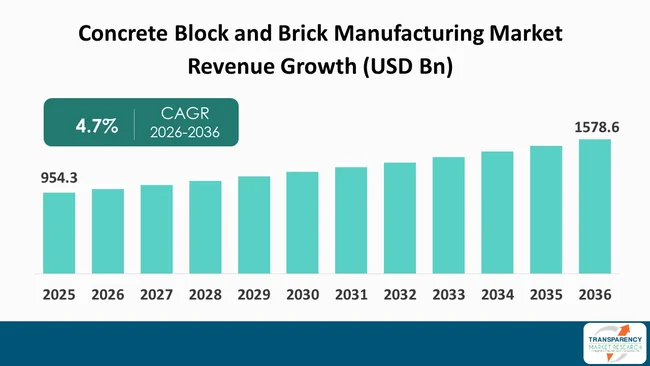
The global concrete block and brick manufacturing market size was valued at US$ 954.3 billion in 2025 and is projected to reach US$ 1578.6 billion by 2036, expanding at a CAGR of 4.7% from 2026 to 2036. The market growth is driven by surge in urban construction activities and growing emphasis on environmental sustainability
Market Size & Highlights
- The concrete block and brick manufacturing market reached US$ 954.3 billion in 2025
- The market is expected to climb to US$ 1578.6 billion by 2036
- The concrete block and brick manufacturing industry is anticipated to expand at a CAGR of 4.7% from 2026 to 2036
- Top companies in the concrete block and brick manufacturing market include CRH, Boral, CEMEX, S.A.B. de C.V., and Xella International
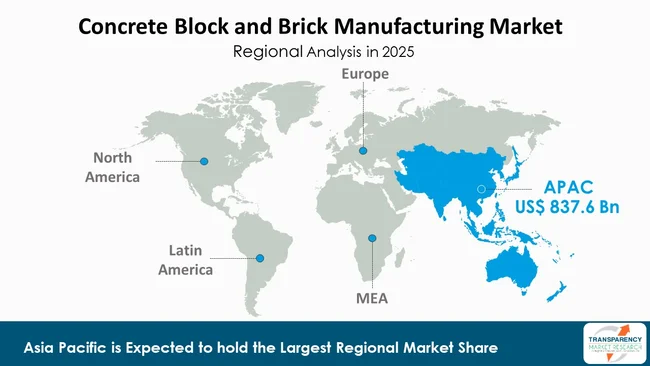
- Asia Pacific dominated the market in 2025, holding the largest revenue share of 87.8%.
- By type, brick held the largest share of 81.6% of the market in 2025
Analysts’ Viewpoint on Concrete Block and Brick Manufacturing Market Scenario
Rapid urbanization, development of infrastructure, and sustainable construction activities are expected to propel growth within the market size for concrete block and brick manufacturing.
The need for concrete blocks and bricks is high. This is due to the continuous increase in building activities throughout the world. Urbanization patterns, especially in developing countries, are driving growth in the market.
Technological advancements are improving the efficiency of manufacturing processes and extending the variety of raw materials used. In addition, the green buildings initiative is contributing toward the development of new green building materials and manufacturing techniques. The green initiative are the major factors in the progression of the concrete blocks and bricks manufacturing market.
Global Concrete Block and Brick Manufacturing Market Overview
The concrete blocks and bricks manufacturing industry is looked upon as a cornerstone with regards to the construction sector across the globe. The importance of such an industry is envisaged with respect to the continuously increasing area under construction globally.
With the growth of urbanization resulting in the formation of cities and increased infrastructure, the use of concrete blocks and bricks is likely to increase in the years to come, owing to their flexibility and durability, thereby making them the building blocks of many constructions in the country.
Moreover, not only is the market fueled by the sheer number of construction activities, but this industry is also known to be receptive to changing trends. Recognition of the importance of green building solutions is gaining momentum from various countries and governments, and this sector is actively engaging in these paradigm shifts.
With an ever-increasing world population moving to urban centers and the emphasis on sustainability, the building block and brick industry sits right at the heart of creating our world, thereby balancing strength, cost, and sustainability.
| Attribute | Detail |
|---|---|
| Drivers |
|
Surge in Construction & Infrastructure Activities Augmenting Concrete Block and Brick Manufacturing Market Value
As economies strive toward urbanization development and infrastructure creation, the demand for reliable and flexible infrastructural materials such as concrete blocks and bricks has never been higher. The development of the construction industry involves residential, industrial, and commercial activities, which are highly dependent on the availability of consistent and substantial quantities of such materials.
The idea that smart city initiatives and sustainable development require optimal and sustainable construction solutions is driving the market for concrete block and brick production.
Infrastructure comprising road, bridge, or public utility developments are market expansion opportunities with good growth prospects. Blocks of concrete and bricks are vital components of infrastructure projects because of their long-lasting and flexible nature. At present, every government in the world is investing highly in such infrastructures, ensuring better connectivity and more growth in the future, thereby increasing the long-term market scope of this vital architectural component.
Thus, the rise in building and infrastructure activities globally can be stated to be a major factor that increases the market revenue of the concrete blocks and bricks industry
Growth in Emphasis on Environmental Sustainability
One of the notable concrete block and bricks production industry trends is the focus of manufacturers on building sustainably. The trend toward undertaking environmentally-friendly construction activities has a significant impact on the market. In this respect, concrete block and bricks, particularly Autoclaved Aerated Concrete (AAC) Blocks, have emerged as the major contributors.
AAC blocks, which are known for the low weight and insulation properties of the blocks, are becoming increasingly popular owing to their eco-friendly nature. The production of AAC blocks is seen to have a lesser environmental impact when compared to the manufacturing of the other bricks. This is also in accordance with the ongoing trend of the demand for energy-efficient building materials.
The focus on sustainable construction extends to the lifespan of the building itself. AAC blocks help in energy efficiency by minimizing the requirement of extra heating or cooling. As an outcome, they are a popular choice among ecologically aware builders as well as architects seeking to achieve green construction certifications and requirements. As the industry continues to prioritize environmental responsibility, AAC blocks are poised to play a critical role in addressing the requirement of sustainable construction solutions.
Bricks – Prominent Type Segment for Concrete Block and Brick Manufacturing Market
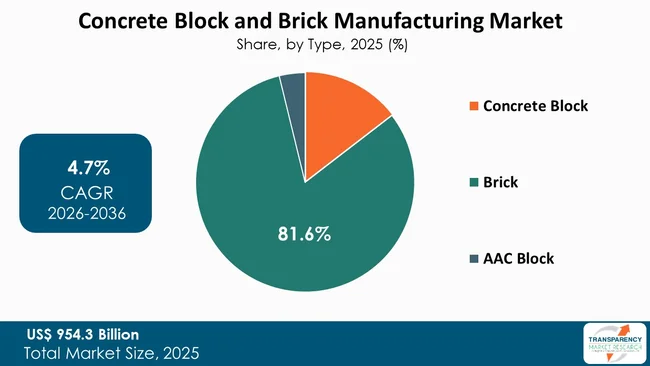
Bricks accounted for largest share of 81.6% in the concrete block and brick manufacturing market in 2025 due to their long-standing use in the construction of low-rise individual buildings, especially throughout Asia-Pacific, the Middle East, and parts of Europe. Bricks are chosen for their longevity, thermal mass, the flexibility of design, and compatibility with traditional construction methods. Within bricks, clay-based bricks held 83.8% share mainly due to the abundant raw materials, the established kiln facilities, and it’s proven long-term performance. Furthermore, clay bricks provide better weather resistivity and lifecycle stability; therefore they are the preferred choice in new construction, renovation, and facade applications, which results in an increasing demand as compared to concrete blocks.
Residential – Prominent End-use for Concrete Block and Brick Manufacturing
The residential segment held the largest share of the concrete block and brick manufacturing market in 2025 as house construction is naturally masonry-intensive. Bricks and concrete blocks are preferred for walls in single-family houses, low-rise apartments, and affordable housing projects, especially in the Asia-Pacific and the other emerging regions. Due to their cost efficiency, local availability, thermal comfort, fire resistance, and ease of construction, they are usually the choice of builders for residential housing. Furthermore, ongoing urbanization, population growth, and renovation of the aging housing stock driving the demand.
Commercial buildings use concrete blocks for partitions, basements, and service walls, but the use of steel and glass reduces the masonry part. Infrastructure projects predominantly use reinforced concrete, and masonry is only used for boundary walls and small buildings. The industrial sector is highly selective, focusing mostly on the use of masonry for enclosures and non-critical structures, thus, holding a lower share.
Key Opportunity for Concrete Block and Brick Manufacturing Market
| Attribute | Detail |
|---|---|
| Opportunity |
|
In mature construction markets in North America and Europe, renovation provides an attractive opportunity to concrete block and bricks manufacturers. In these regions aging buildings increasingly requires structural upgrades and performance improvements to meet regulatory compliance. These are compatible with the existing concrete structure without demolishing it entirely. The major applications include load-carrying walls, fire-resistant partitions, replacement of façades, basements, and seismic retrofitting, all of which involve durability and reliable performance of masonry.
Regulatory imperatives for fire safety, energy efficiency, and climate resilience will also promote more rapid renovation cycles. For business, renovation projects call for standardized but versatile masonry products that can be optimized for size, density, and thermal performance to meet site-specific constraints. This creates opportunities for suppliers to offer higher-margin, application-specific blocks and bricks rather than competing solely on volume.
Besides, renovation demand is usually local and repetitive; this can enable regional manufacturers to use proximity and efficiency in logistics as their competitive advantages. As the spotlight moves to renovation from new construction in developed economies, suppliers get stable business growth.
Regional Concrete Block and Brick Manufacturing Market Insights
| Attribute | Detail |
|---|---|
| Leading Region |
|
Asia Pacific led the world market in concrete block and brick manufacturing with 87.8% in 2025, and this trend is projected to continue. In fact, this region hosts more than half of world brick kiln count and is witnessing a rise in its brick demand, primarily due to the increase in construction activity.
By contrast, Europe is expected to lose market share by the end of the forecast period with a market share of only 5.2% by 2025. Latin America and Middle East & Africa, as per the latest forecast for the market for concrete block and brick manufacturing, have a positive growth trend, which reflects the steady pace at which these two regions have been increasing their building activities. Building being an important factor that affects the market for concrete blocks and bricks means that the above reflects a changing market environment that has been shaped by varying levels of market growth and market share over time.
Analysis of Key Players in Concrete Block and Brick Manufacturing Market
The concrete block and brick manufacturing industry is dominated by multiple companies who employ a number of strategies to expand their market share and retain their leadership. Most firms are investing significantly in the R&D of new products to expand their product portfolio. Manufacturers are also collaborating with other companies to increase their concrete block and brick manufacturing market share.
CRH, Wienerberger AG, Boral, UltraTech Cement Ltd, Xella Group, CEMEX S.A.B. de C.V., Lignacite Ltd, GENERAL SHALE, INC., Brickworks, Midwest Block & Brick, Monaprecast, Midland Concrete Products, Magicrete Building Solutions Pvt. Ltd., and Lightweight Construction Co. (LCC-Siporex) are the significant players in the market.
Key players in the concrete block and brick manufacturing market research report have been profiled based on various parameters such as company overview, financial overview, business strategies, product portfolio, business segments, and recent developments.
Concrete Block and Brick Manufacturing Market Developments
- In January 2026, Lontto revealed a high-volume brick press machine aimed at significantly increasing manufacturing efficiency, extending the life of machines, and giving the block and brick production process more flexibility. With this improved machinery performance higher throughput and lower unit costs can be achieved. This will expected to strengthen the competitiveness of large-scale producers as well as regional manufacturers.
- In April 2025, Wienerberger announced that it had expanded the product portfolio of thermally optimized and façade- oriented bricks to address the stringent energy-efficiency regulations as well as the raised renovation activity in mature markets. Strategically, this step reinforced Wienerberger’s position in the premium residential and refurbishment sectors, where thermal performance, aesthetics, and regulatory compliance have become the key factors influencing the choice of materials.
Concrete Block and Brick Manufacturing Market Snapshot
| Attribute | Detail |
|---|---|
| Market Size Value in 2025 | US$ 954.3 Bn |
| Market Forecast Value in 2036 | US$ 1578.6 Bn |
| Growth Rate (CAGR) | 4.7% |
| Forecast Period | 2026-2036 |
| Historical Data Available for | 2021-2025 |
| Quantitative Units | US$ Bn for Value and Million Units for Volume |
| Market Analysis | It includes cross-segment analysis at the global as well as regional level. Furthermore, the qualitative analysis includes drivers, restraints, concrete block and brick manufacturing market opportunities, key trends, Porter’s Five Forces analysis, value chain analysis, and key trend analysis. |
| Competition Landscape |
|
| Format | Electronic (PDF) + Excel |
| Market Segmentation | Type
End-use
|
| Regions Covered |
|
| Countries Covered |
|
| Companies Profiled |
|
| Customization Scope | Available upon request |
| Pricing | Available upon request |
Frequently Asked Questions
How big was the concrete block and brick manufacturing market in 2025?
The concrete block and brick manufacturing market was valued at US$ 954.3 Bn in 2025
How is the concrete block and brick manufacturing market expected to grow by 2036?
The concrete block and brick manufacturing industry is expected to grow at a CAGR of 4.7% from 2026 to 2036
What are the key drivers of the concrete block and brick manufacturing market?
Surge in urban construction activities and growing emphasis on environmental sustainability
Which was the largest segment of the concrete block and brick manufacturing market in 2025?
Brick was the largest type segment and its value is anticipated to grow at a CAGR of 4.4% during the forecast period
Which region was the most lucrative in the concrete block and brick manufacturing market in 2025?
Asia Pacific was the most lucrative region in 2025
Who are the prominent players in the concrete block and brick manufacturing business?
CRH, Boral, CEMEX S.A.B. de C.V., Xella International, Wienerberger AG, and UltraTech Cement Ltd. are the major players in the concrete block and brick manufacturing market